A Holy Limp
Recently, I shared my story with the ladies in a trauma recovery class that I teach. As I described my responses to miscarriage, infertility, and divorce, one of the ladies made a statement that made me think. “You’ve really wrestled with God.” She said it like it was a negative, her tone implying that I was lucky to have come out the other side of that still a Christian. But I believe that, far from being a dangerous and rebellious activity, wrestling with God is often the best way to preserve our faith and the only way to grow through hard situations in our lives.
Let me start at the beginning. Twenty-five years ago, I was a young pastor’s wife. After both attending a secular university and earning degrees, my husband and I felt called into ministry, specifically ministry to university students. We entered a ministry training program, then became pastors of a student ministry at our alma mater. It was a financial struggle, but we knew it was God’s call on our lives.
When we decided to start a family, I quickly became pregnant, and our students rejoiced with us. Unfortunately, at nineteen weeks, there was no longer a heartbeat, and our baby passed away. I remember the grace that covered me in the immediate aftermath of the tragedy. But as time went on and I was unable to conceive again, and even worse, as my infertility was linked to a mistake made by the doctor during the D & C procedure that they routinely perform after a miscarriage, I began to be angry at God. When two, then three years had passed, and I was unable to get pregnant again, those feelings intensified.
But in that intense anger was the wrestling. Because there was no one else to bring those feelings to, I kept bringing them to God. Often, I brought them in questionable ways, but still, I brought them. Well, maybe questionable is too kind a term for it. I remember once, specifically, when I had painted my kitchen cabinets and put the doors outside in the sun to dry. Within a few minutes, and seemingly out of nowhere, it started raining on them. I rushed outside, and seeing that they were already ruined and were going to have to be repainted, I stood in the middle of my front yard. I cringe now as I remember looking at the sky and screaming, “So this is how it is? Whatever I don’t want, that’s what you do? Do you even care about me at all, or is this just some big game to you?”
During this time, I remember saying to my husband that I was so tired of fighting. He asked me once what I was fighting for. I said, “I’m fighting to hold onto my faith.” Yet during this time, the God I was fighting to hold on to was fighting to hold on to me, too. He spoke plainly, even when I didn’t want to hear it. I remember the time I went to a retreat for women in ministry, and so many women were there who were pregnant or nursing that I called my husband to come get me from several hours away. When he refused, I went to my room with the word “hopeless” resonating in my heart. The next morning, when I went to the first session, there were boxes at each place. The woman who was leading told us that she had written words on small stones and placed one in each box, then prayed as she set them down that God would guide each woman to a word that she needed. When I opened my box, the word “hope” was printed neatly in gold across it.
But here’s the truth about wrestling through our pain with God–it’s not neat or pretty. Although there are beautiful moments in the middle of the ugliness, moments when God directly touches us, grief isn’t beautiful. But it can be holy. Because through all of the ugliness of our pain, we can keep running to Jesus. Running with fists clenched, perhaps, but still running in the right direction.
Nearly fifteen years after Jesus and I wrestled through miscarriage, infertility, and eventually adoption, we would be wrestling again. The husband who had been strong during that trial lost his way, and in the process, he turned his back on God, me, and our children. And again, I had to wrestle through pain and disappointment. But the blessing of having wrestled with God is that we become stronger. This second round of wrestling felt different. I had held on once, and I knew I would hold on again.
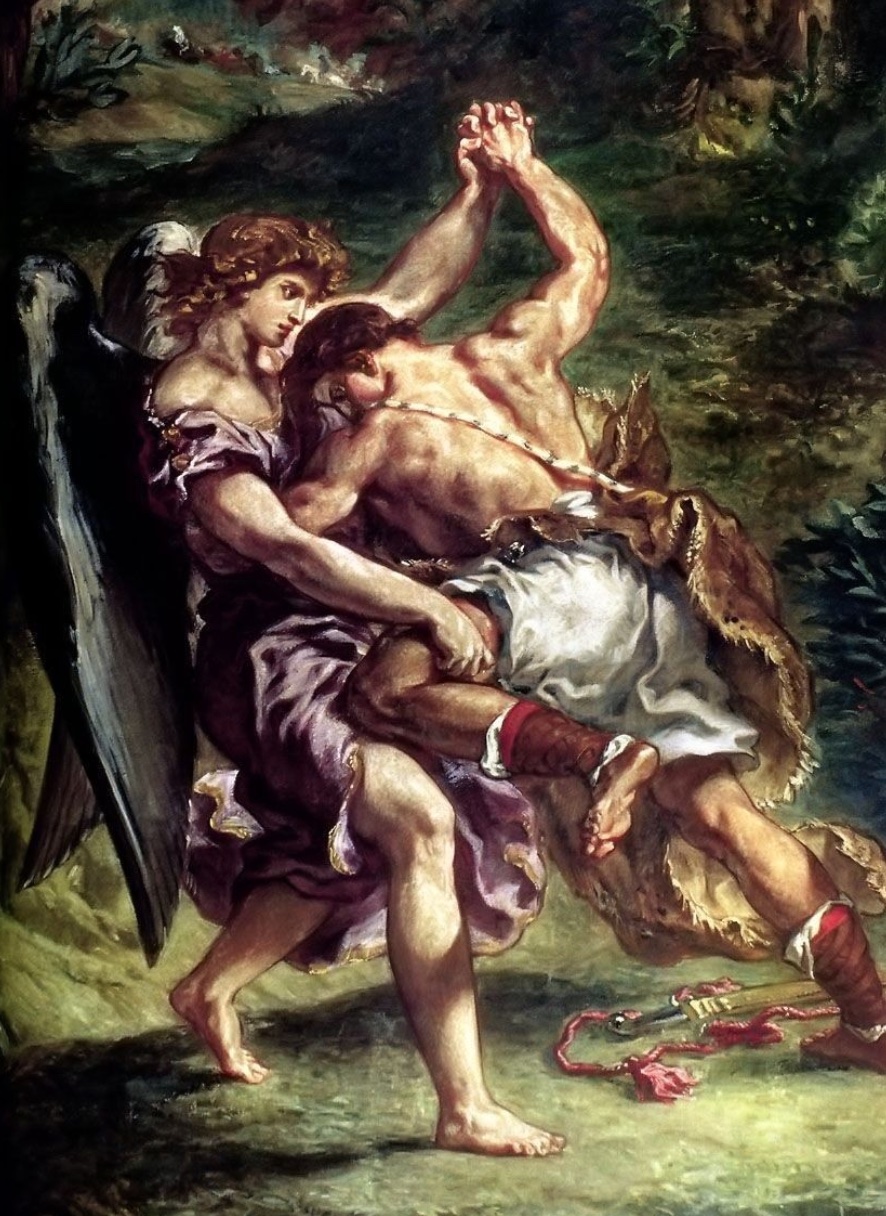
In Genesis 32, we see Jacob in crisis. He has prospered in the land of his ancestors, where he had run from his brother, who wanted to kill him. Now he was on his way back home, and he heard that his brother was on his way to meet him with an army. He divides his large family into two groups, the Bible tells us, hoping that if one is attacked, the other may survive. He’s basically coming to terms with half of his family being killed in hopes that he can save the other half. Then he goes off alone. The Bible doesn’t tell us that his goal was to pray, but in that situation, prayer is the natural response. And the Bible does tell us that God Himself showed up.
He didn’t show up with soft, reassuring words. God himself reached in and grabbed Jacob in a holy headlock. Jacob is angry and scared, and instead of telling him to calm down, God met him right where he was. And Jacob, with more sense than he normally had, held on to God for dear life.
In that encounter, God changed who Jacob was. As morning approached and Jacob refused to let go, the Man he was fighting wounded his hip. Jacob would have a permanent physical reminder that he had wrestled with God and prevailed. Then He changed Jacob’s name. Jacob means deceiver or supplanter–an accurate representation of who he had been. After all, the reason he expected his brother’s attack was that he had deceived their father in order to receive his brother’s inheritance. But God changed Jacob’s name to Israel. Israel literally means “he struggles with God.” Wrestling with God became his identity.
There are three things I’ve learned from this passage about wrestling with God. The first is that wrestling implies proximity; we cannot wrestle with God while walking away. Holding on tightly to Jesus in our pain isn’t passive or idle. It is a forceful reckoning with the idea that God is big enough to handle our feelings.
Secondly, wrestling acknowledges dependence. Struggling with God in our fear and anger is a confession that we can’t get what we seek anywhere else. Like Peter in John 6:68, wrestling with God asks, “Where else would I go?”
Last, and perhaps most importantly, wrestling never leaves us unchanged. God left Israel with a different name and a different walk than he had before. He could never forget that he had held on to God, wrestled with God, and won.
Israel called the place Peniel, which means “face of God.” In his wrestling and his determination not to let go, he saw God. He now knew God in a way he never had before. And if you’ve ever wrestled with Jesus through your pain, you understand that it was worth it. The fear, the anguish, the limp–all worth it when we have seen God, known Him more deeply, and been made closer to who He destined us to be.
 Redemptive Ramblings